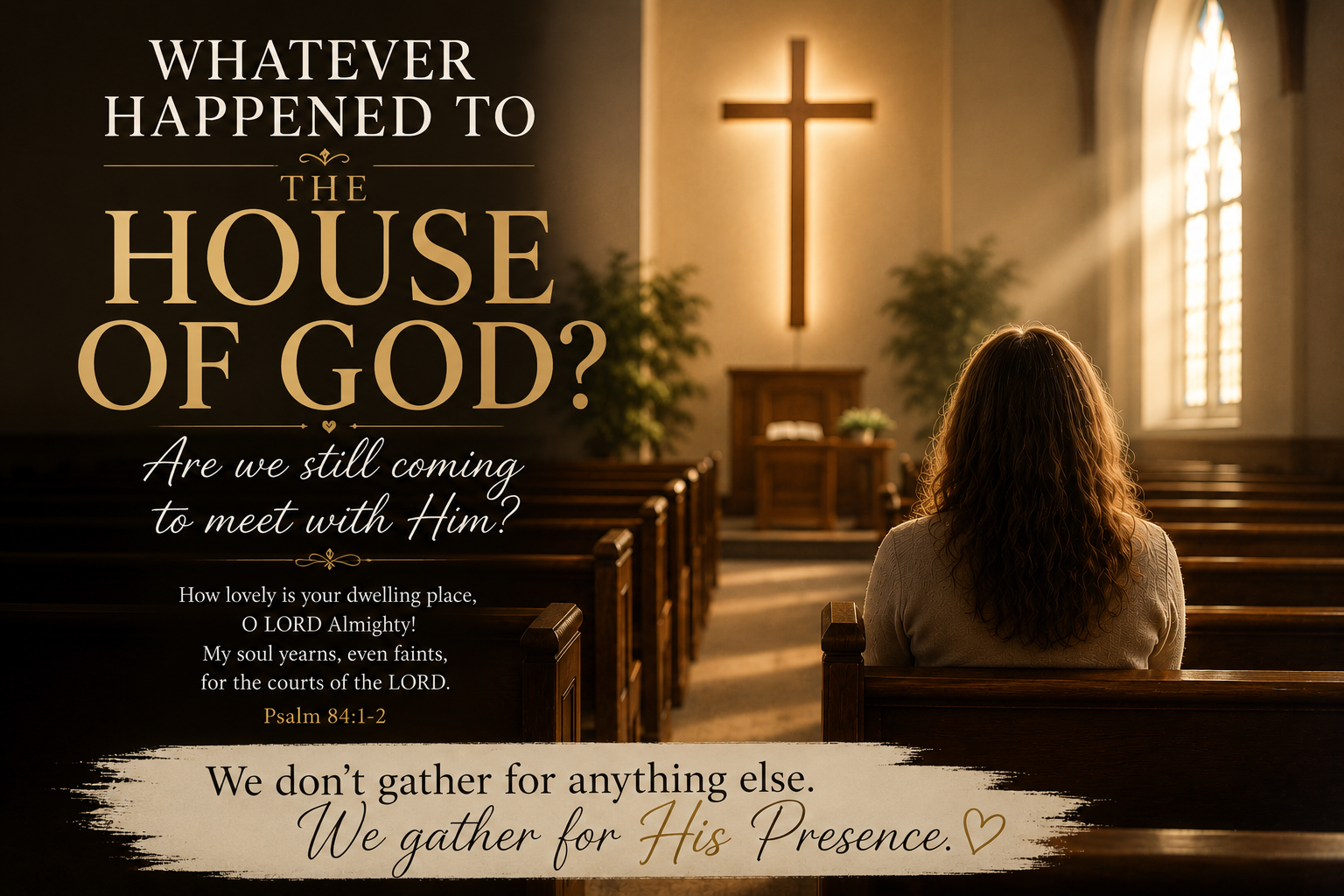
Whatever Happened to the House of God?
When I was five years old, I remember kneeling in church and praying a very simple prayer. I asked God to help me talk to Him. I didn’t know much theology. I didn’t understand everything about God. I was just a little girl who had been taught that God was real, that He was holy, and that His house was a place where we came to meet with Him. And somehow, that understanding has stayed with me all these years.
When I look at the American church today, I sometimes find myself asking a difficult question: Whatever happened to the reverence we once had for the house of God? I realize that buildings are not the church. We are the church. The New Testament makes that very clear. And I am not suggesting that a particular style of building, clothing, music, or worship is the measure of whether a church is biblical. But I am asking what our surroundings—and our methods—communicate about what we believe is happening when we gather together.
Because in many churches today, the sanctuary has been transformed into something that looks remarkably like a concert venue. The altar has disappeared in some places, replaced by a stage. The cross is sometimes nowhere to be seen. There are elaborate lighting systems, huge screens, professional sound equipment, smoke machines, and carefully choreographed worship sets. A team of professional musicians stands on the platform, and the music can become so loud that you can barely hear the congregation singing. People stand for the entire worship service. Hands are raised. People clap. Some dance. Some cry.
Now, let me be very clear. I am not saying those people aren’t worshiping God. They may be genuine worshipers. They may love Jesus with all their hearts. They may be completely sincere. The Bible certainly gives us examples of exuberant worship. There is nothing inherently wrong with raising our hands, clapping, singing loudly, or even dancing before the Lord. The question isn’t whether worship can be expressive. The question is whether worship has become entertainment.
Because if an unbeliever walks into our church today, what do they see? Do they see something completely foreign to the world—or something that looks remarkably familiar? They’ve been to concerts. They’ve seen stages. They’ve seen lights. They’ve heard professional singers. They’ve watched performers move around a platform. They’ve experienced carefully produced emotional moments. So when they walk into a church and see virtually the same thing, only with Christian lyrics, what distinguishes the gathering of God’s people from the entertainment they left behind? That question deserves our attention.
When Did We Decide Children Needed a Different Church?
I grew up going to church with my parents. Children sat with their parents. We listened to the same sermons. We watched our parents worship. We learned how to behave in church. We learned that we were entering a place where people came together to worship God. My own children went into church with us when they were growing up. They heard the Word. They watched us. They learned by observing the adults around them.
Then something began to change in the American church. We developed “children’s church.” Again, let me say this carefully: I am not suggesting that every children’s ministry is bad. There are wonderful children’s pastors and teachers who love children and faithfully teach them Scripture. But somewhere along the way, we began creating an entirely different church experience for children. Puppets. Games. Skits. Songs. Entertainment. Bible stories simplified to keep their attention.
And I began to wonder: Are we teaching children about God—or simply teaching them stories about people in the Bible? Do they know that God is holy? Do they understand that He is faithful? Do they know that He is worthy of reverence? Do they understand sin, repentance, obedience, holiness, sacrifice, and surrender? Do they understand that Jesus isn’t merely their friend who wants to make their lives better, but their Lord and King? Because there is a difference between knowing about God and actually knowing God.
And then they grow older. They go to youth group. And often the entertainment simply changes. The games become bigger. The music becomes louder. The lights become brighter. The methods become more sophisticated. We tell ourselves that we have to keep their attention. But I wonder if we’ve created a generation that has been trained to believe that church must entertain them in order to hold their attention. And then they become adults. And they begin looking for a church. What are they looking for? Perhaps something that feels familiar. Something that looks like what they grew up with. Something that gives them an experience. And perhaps we’ve unintentionally trained them to ask: “What can this church do for me?” instead of: “What does God require of me?”
When Did We Become Afraid of Holiness?
I remember dressing up to go to church. Why? Because we were going to the house of God. Was a suit required by Scripture? No. Does God care whether we wear a dress, a suit, jeans, or something else? Our clothing is not what makes us holy. But there was something in the attitude behind it. We were coming before God.
Today, I’ve watched the pendulum swing so far in the other direction that sometimes pastors seem almost afraid to look like pastors. T-shirts. Shredded jeans. Baseball caps. Casual language. Again, none of these things are inherently sinful. But I have to ask: When did our desire to relate to people become more important than our desire to honor God? We have become obsessed with being relevant. But perhaps the church’s greatest need isn’t relevance. It’s holiness.
People don’t need another concert. They don’t need another motivational speech. They don’t need another carefully manufactured emotional experience. They need Jesus. They need to know that there is a God who created them, loves them, sees them, and calls them to repentance. They need to know that Jesus Christ is Lord. They need to know that sin has consequences. They need to know that forgiveness is available through the cross. They need to know that the Holy Spirit doesn’t merely make us feel something. He changes us.
We Didn’t Lose the Church Overnight
I don’t believe there was one day when someone decided, “Let’s turn church into entertainment.” It happened gradually. One accommodation at a time. One innovation at a time. One attempt to make church more attractive. One attempt to get more people through the doors. One attempt to keep the children interested. One attempt to keep the teenagers engaged. One attempt to compete with the culture. And eventually, perhaps without realizing it, we began bringing the culture into the church rather than bringing the truth of Christ into the culture.
We started asking: How do we get people to come? Perhaps we should be asking: What are we asking them to come to? Are we calling people to follow Jesus? Or are we inviting them to attend an experience? Are we making disciples? Or are we building audiences? Are we preparing people for eternity? Or are we simply trying to make Sunday morning enjoyable? Those are not the same thing.
I’m Not Calling for a Return to the Past
I don’t want to go backward simply because something is old. Not every tradition was biblical. Not every old hymn was sung from a sincere heart. Not every pastor in a suit was holy. And not every modern worship service is superficial. God is not impressed by our lighting systems—or offended by a guitar. He looks at the heart. But perhaps that’s precisely why we need to examine ours.
Why do we do what we do? If the lights went out, would we still worship? If there were no professional musicians, would we still sing? If there were no smoke machine, would we still sense the presence of God? If there were no emotional music building toward a climax, would we still weep over our sin? If the pastor stood in a plain room with nothing but a Bible, would we still hunger for the Word? If nobody applauded us, would we still serve? If nobody noticed us, would we still obey? Those questions cut deeper than whether our church has a stage or an altar. Because the issue isn’t really the stage. It’s the heart.
Let’s Put God Back at the Center
Perhaps what we need isn’t a new worship style. Perhaps we need a fresh revelation of who God is. He is holy. He is faithful. He is merciful. He is righteous. He is worthy. He is King. He is Lord. And when we truly understand who He is, something changes inside of us. We don’t have to manufacture reverence. We don’t have to manufacture emotion. We don’t have to manufacture excitement. When people truly encounter the living God, they respond.
When Isaiah saw the Lord, he became aware of his own sin. When Peter encountered Jesus, he recognized his unworthiness. When Moses stood before God at the burning bush, God told him to take off his sandals because he was standing on holy ground. The New Testament tells us that when we gather, Christ is in our midst. So perhaps we should ask ourselves: Do we really believe that? If Jesus walked through the doors of our church this Sunday, would we treat the gathering differently? Would we still be more concerned with the production than with His presence? Would we still be more concerned with impressing people than honoring Him? Would we still be more concerned about whether people had a good experience than whether they encountered the truth?
I don’t want to return to the past. I want to return to God. I want our children to know more than Bible stories. I want them to know the God of the Bible. I want our teenagers to learn more than how to enjoy church. I want them to learn how to follow Jesus. I want our pastors to remember that they are shepherds, not celebrities. I want worship leaders to remember that they are leading people toward God, not performing for an audience. And I want all of us—including me—to remember why we gather.
We don’t gather because we need another concert. We don’t gather because we need another emotional experience. We don’t gather because Sunday morning needs to compete with the entertainment industry. We gather because God is worthy. And perhaps the question we need to ask isn’t: “Whatever happened to the house of God?” Perhaps the question is: “Whatever happened to our awe of God?” Because when we recover our awe of Him, I believe we will recover something else too. Worship. Not manufactured worship. Not performed worship. Not entertaining worship. But worship that comes from hearts that have seen the King. And when that happens, perhaps we won’t need to make church look like the world anymore.
Enjoyed this post?
Get daily meditations and encouragement delivered to your inbox